Myers & company



Even before I started law school I knew what attorneys did. They were paid to talk. To use words to make things seem a certain way. Law school did nothing to disabuse me.
For the first couple decades of practice I continued to believe that my job was about output. I wanted to minimize what I took in and maximize what I put out. Information flowed mainly in one direction.
But over time things changed. I received this text message from a friend last week. It really crystallized my (relatively new) understanding of how I could be most effective.
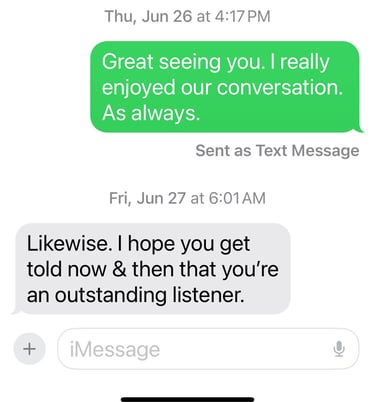
I probably spent 90 percent of my time talking and 10 percent listening when I started practice. Now I spend 90 percent of my time listening and 10 percent talking. (In fairness, this also has a lot to do with the fact that I say the same things to most clients and have gotten pretty concise.)
Listening seems like a lot less work than talking. But for me, at least, it’s a lot more challenging. My brain needs to work harder to follow someone else’s train of thought. And I need to figure out how to encourage, elicit and clarify without taking over the narrative. Those kinds of nuances burn through a lot of energy. But it’s energy well-spent.
As I was putting together this newsletter I took a break. (I’m supposed to rest my brain every 15 minutes. But I find that scrolling through Tumblr accomplishes just about the same purpose.) Anyway, I was scrolling and this popped up:
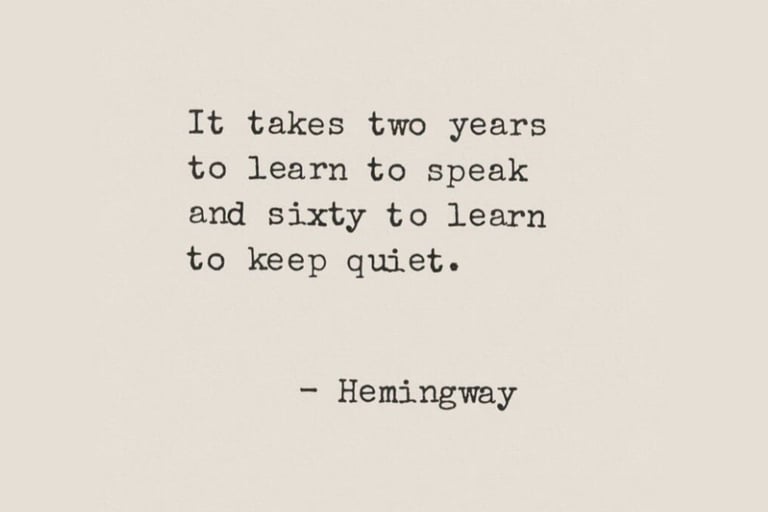

The timing was right for me to appreciate it. It seems like there’s a series of invisible connections in the universe.
But back to the point. People with expertise should spend the majority of their time listening and then—after having heard and filtered the information—provide assistance and the benefit of their experience to others.
Myers & Company
Personal Injury Attorneys
© 2024. All rights reserved.